Key points
- GR00T 2 uses a world-action model to predict future video frames and motor commands.
- Success rates ranged from 10 to 80 percent, with some tasks requiring minimal additional training.
Nvidia reported that its GR00T 2 model achieved success rates between 10 and 80 percent in lab tests involving tasks like lighting matches and slicing bananas, according to the published report The company stated these results came from transferring human hand movements captured on video to robotic arms without traditional teleoperation.reported
Evidence: reported
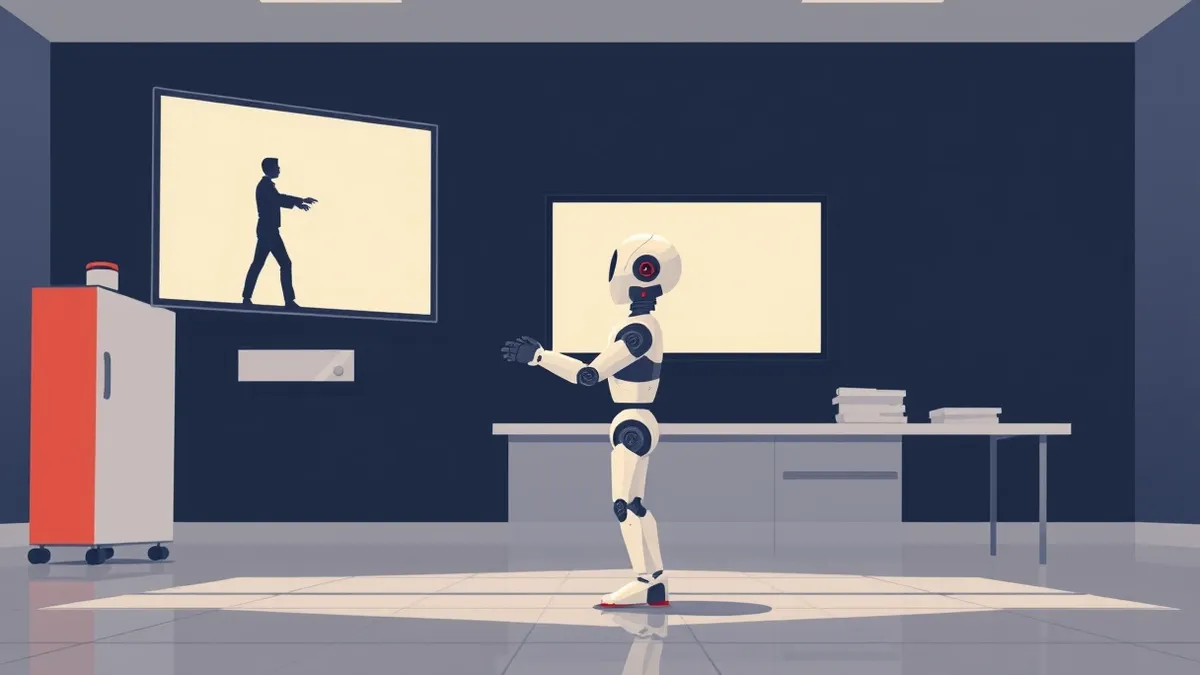
Nvidia's model GR00T 2 watches humans on video, then imagines itself as the robotaifleet-decoder
How we got here
Previous methods for teaching robots new tasks required engineers to spend hours remotely controlling the machines, a process known as teleoperation. This approach was described as expensive and slow, requiring separate data for every robot model. Nvidia’s predecessor, GR00T 1, translated camera images and language commands directly into motor movements.reported
Evidence: reported
Nvidia's model GR00T 2 watches humans on video, then imagines itself as the robotaifleet-decoder
What is new
The new GR00T 2 acts as a world-action model, calculating the next movement while simultaneously generating a short video of the immediate future.reported
Evidence: reported
Nvidia's model GR00T 2 watches humans on video, then imagines itself as the robotaifleet-decoder
Reading between the lines
To teach a new task, a person demonstrates steps using data gloves or finger exoskeletons. The AI combines these recordings with general motion data from the target robot, generating the robotic arm in its video prediction to derive control commands. For longer assembly work, Nvidia pairs the system with a higher-level language model like OpenAI’s GPT-6 Astra, which helps with errors but slows the robot down.reported
Evidence: reported
Nvidia's model GR00T 2 watches humans on video, then imagines itself as the robotaifleet-decoder
The open questions
The primary uncertainty lies in the reliability of the transfer learning. While the model learned to hammer nails from a single video via simulation, success rates for physical tasks varied significantly. For 50 selected tasks, less than three minutes of conventional training raised success from 40 to 95 percent, but this improvement was not universal across all tested scenarios.reported
Evidence: reported
Nvidia's model GR00T 2 watches humans on video, then imagines itself as the robotaifleet-decoder
Why it matters
- Evaluators must account for the 10-80 percent success rate variance when benchmarking video-based imitation learning models.
- The use of 400,000 hours of video data highlights the significant compute and data requirements for training world-action models.
- The pairing with OpenAI’s GPT-6 Astra introduces latency trade-offs that impact real-time robotic assembly applications.
- The shift from direct translation to predictive video generation changes how model errors manifest during physical execution.
Topics: robotics, Nvidia, imitation learning, AI models, automation
Updated
Then / now / next
Robot training relied on laborious teleoperation and direct image-to-motor translation.
GR00T 2 uses video prediction to transfer human movements to robots with varying success.
Observers should watch for standardized benchmarks comparing teleoperation costs against video-based training efficiency.
Story timeline
- Then Robot training relied on laborious teleoperation and direct image-to-motor translation.
- 10 Nov 2026 Nvidia's model GR00T 2 watches humans on video, then imagines itself as the robot
- Now GR00T 2 uses video prediction to transfer human movements to robots with varying success.
- Next Observers should watch for standardized benchmarks comparing teleoperation costs against video-based training efficiency.
The strongest doubt
Counterpoint from the sources
Success rates were as low as 10 percent for some tasks, indicating the model is not yet reliable for all applications without extensive additional training.
Ask the article
Local keyword search of this article; no generated answers.Did this article give you the evidence you needed?
Your choice stays on this device. No public tally.Questions readers ask
How does GR00T 2 differ from GR00T 1?
GR00T 2 predicts future video frames and movements as a world-action model, rather than translating images directly into motor commands.
What is the success rate for new tasks?
Success rates varied between 10 and 80 percent depending on the specific task performed by the robot.
Connected stories
Reading receipt
- GR00T 2 uses a world-action model to predict future video frames and motor commands.
- Success rates ranged from 10 to 80 percent, with some tasks requiring minimal additional training.
Still open: How does the latency from pairing with GPT-6 Astra affect complex assembly line throughput?
Still open: Can the 10 percent failure rate be reduced without reverting to laborious teleoperation?